


River Dredging Sludge Treatment Solution: A Process Overview
Effective management of river dredging sludge is critical for maintaining waterway health, preventing flooding, and restoring aquatic ecosystems. This article presents a technical overview of conventional dredging methods and introduces an advanced mechanical dewatering process that achieves high solids content with minimal chemical addition.
Conventional River Dredging Methods
Two primary approaches are commonly used for sediment removal in rivers:
- Dewatering and Dry Excavation - Suitable for small rivers without flood control, drainage, or navigation functions. Temporary cofferdams are constructed to isolate a section, water is pumped out, and the sediment is removed by dry excavation or hydraulic flushing.
- Underwater Dredging - Dredging equipment mounted on barges excavates sediment from the riverbed. The collected sludge is then transported via pipeline to an onshore receiving area for further treatment.
Sludge Characteristics by Process Stage
Understanding sludge properties at each stage is essential for optimizing dewatering performance. Typical parameters vary depending on the source and treatment step.
Advanced Dewatering Process Flow
The following process flow diagram outlines the key stages from raw sludge intake to final cake discharge.
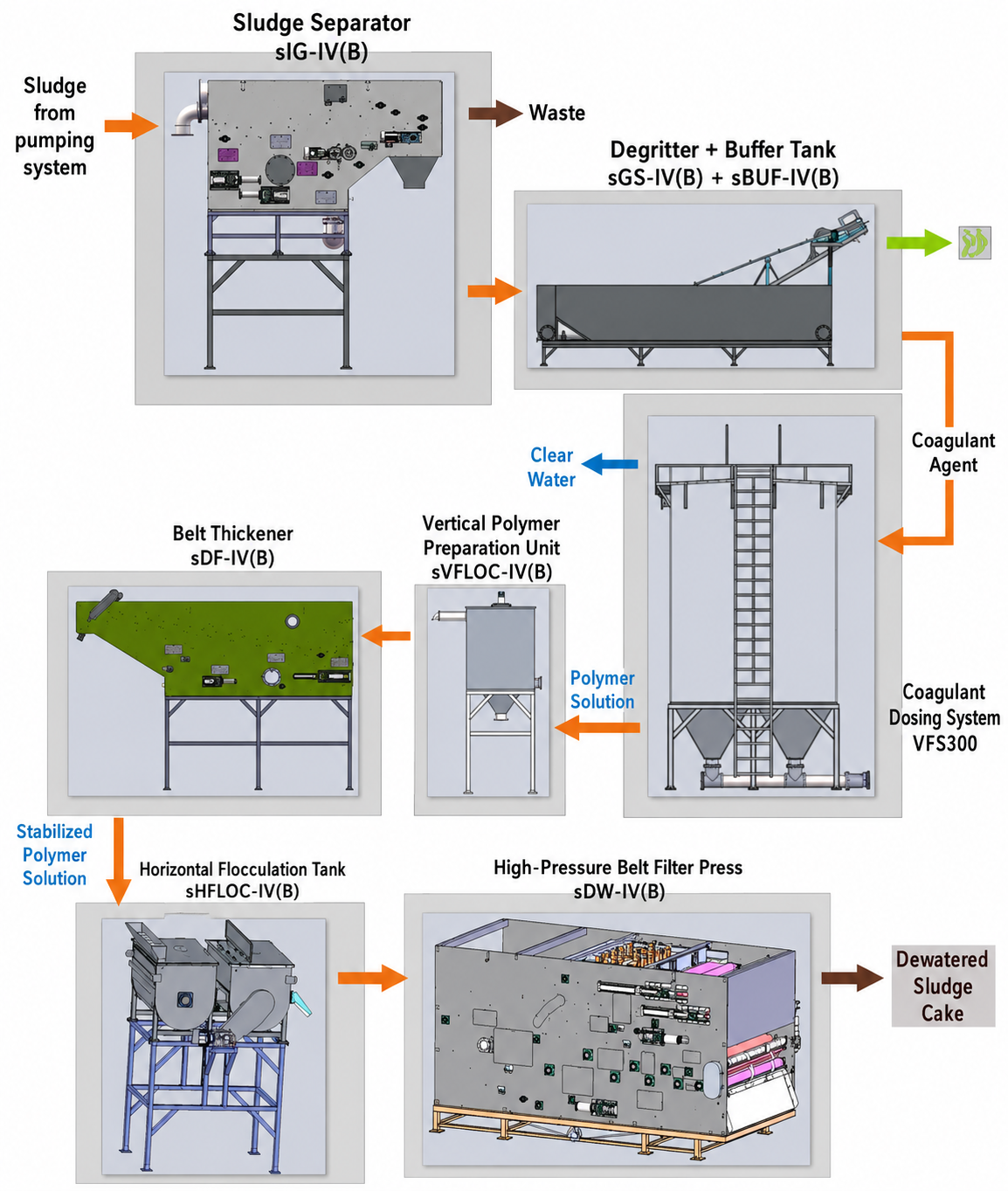
Process Description
The system is designed for high throughput, operational stability, and high automation - capable of unattended operation. Key features include:
• High processing capacity (3 x that of conventional equipment)
• Automated control for reliable operation
• Water recirculation from thickening and pressing stages
• Low capital and operating costs
• Adaptability to diverse river sludge types
Step-by-Step Process
- Receiving and Storage - Sludge is delivered by tanker or conveyor to a receiving tank.
- Dilution and Homogenization - High-pressure water flushes sludge into a dilution tank and then a buffer tank to stabilize solids concentration. Coarse screens remove large particles.
- Grit and Debris Removal - A waste sorting machine removes particles >3 mm. Sand-laden sludge is then directed to a grit removal system.
- First Flocculation - Sludge enters a flocculation tank with a small dose of chemical conditioner.
- Thickening - Flocculated sludge passes through a belt thickener, reducing water content to approximately 75% solids.
- Second Flocculation - Thickened sludge is mixed with a micro-dose of polymer solution before entering the main dewatering unit.
- High-Pressure Dewatering - A high-pressure belt press using felt-type filter technology reduces sludge water content to 30-60%.
- Disposal or Reuse - The dewatered cake is suitable for transport and final disposal or beneficial reuse.
Key Equipment and Operating Principles
- Waste Sorting Machine
Removes solid particles in the 3-30 mm range. Features a simple structure, high throughput, and rapid water drainage.
- Belt Thickener
Uses imported double-layer felt-type filter fabric to reduce sludge to ~75% solids while minimizing polymer consumption. High dewatering efficiency.
- High-Pressure Felt Belt Press
The final dewatering stage achieves 30–60% solids content. Offers high cake solids and large processing capacity.
- On-Site Installations
Field installations demonstrate reliable performance across various river conditions, producing stable, transportable filter cakes.
- Complete System Process Flow Diagram
A full schematic illustrates the integrated flow from raw sludge intake to final cake discharge and water recirculation.